

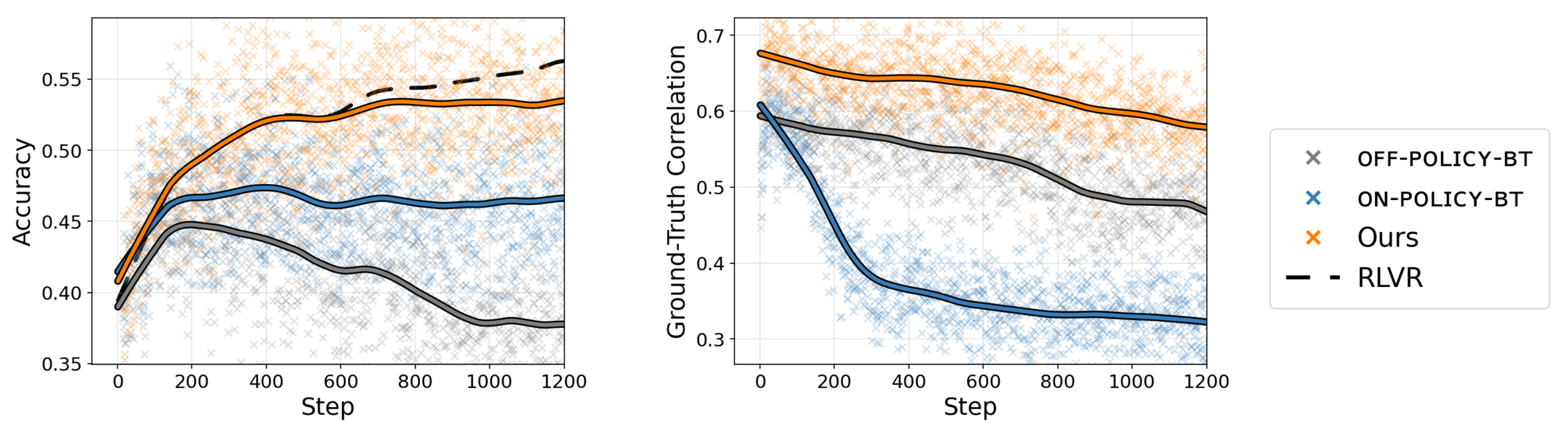
×Off-policy BT×On-policy BT×BoNVoyageRLVR
A reward model should remain useful when its own scores drive optimization. BoNVoyage learns rewards by fitting the policy they induce to preferred demonstrations.
01 / THE PROBLEM
Good at ranking preference data ≠ a good reward signal.
As RL optimizes a learned reward, the policy concentrates on responses the reward model scores highly, including responses that exploit its errors. Reward can keep increasing while actual response quality declines.
Bradley–Terry learns from fixed response pairs. It does not directly train the reward for the response distribution that optimizing it creates.
How do we train reward models for their downstream use in RL?
02 / THE METHOD
Maximize the likelihood of preferred responses under the policy induced by the reward model.
The base language model supplies the reference distribution; β controls regularization. The reward determines which responses become more likely.
Initialize a short Markov chain at a good response selected from the base LM, y⁺.
Rescore a reused candidate pool with the current RM. Accept proposals using reward differences.
Use it as the negative example y⁻ for the reward update.
04 / A REWARD THAT STAYS USEFUL
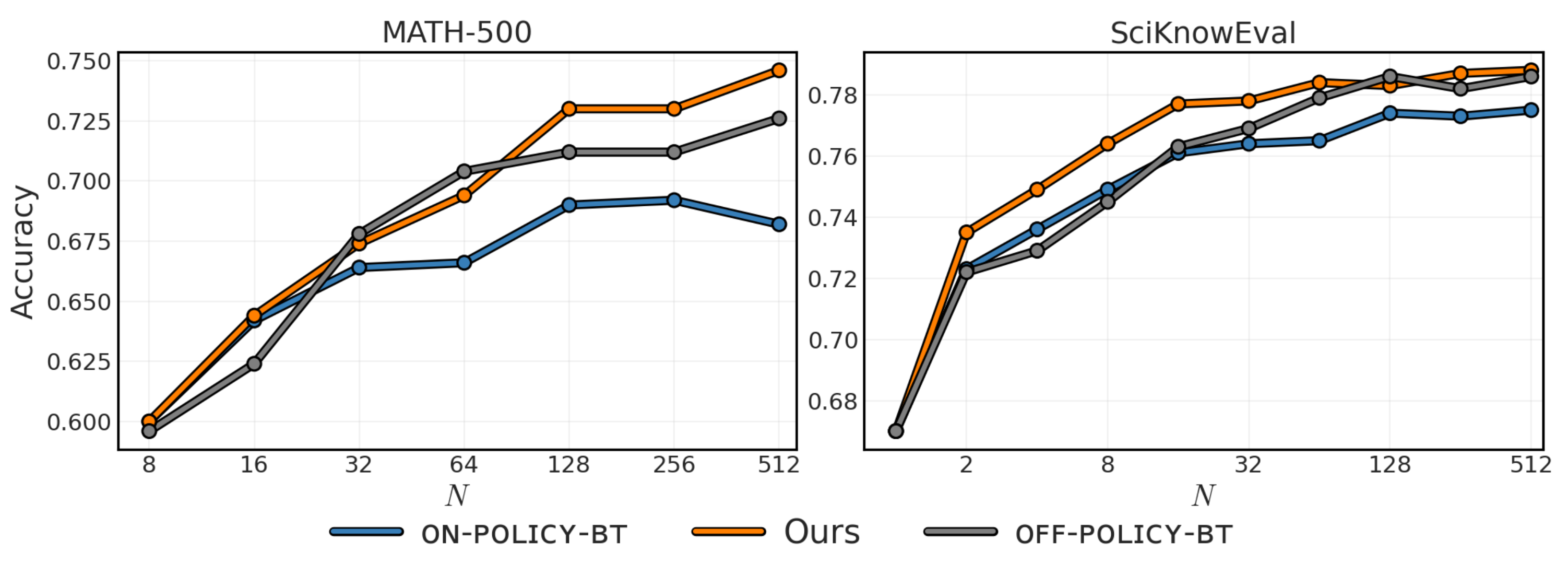
We study the method with 4B reward models and Qwen3-1.7B policies in mathematics and science. We evaluate how the reward behaves during downstream RL and BoN selection.
05 / DOWNSTREAM RL
| Model / reward | Accuracy (%) |
|---|---|
| Base model | 25.2 ± 1.0 |
| On-policy BT | 63.4 ± 1.8 |
| Skywork (Off-policy BT) | 63.0 ± 1.8 |
| BoNVoyage | 67.7 ± 1.8 |
| Method | SciQ | SciKnowEval | ARC-Easy | ARC-C | MMLU-Sci |
|---|---|---|---|---|---|
| Science SFT | 82.5 ± 0.9 | 67.3 ± 1.2 | 79.5 ± 0.6 | 65.7 ± 1.0 | 46.6 ± 1.5 |
| On-policy BT | 91.1 ± 0.7 | 72.2 ± 1.2 | 91.5 ± 0.4 | 78.7 ± 0.9 | 57.4 ± 1.6 |
| Skywork (Off-policy BT) | 90.4 ± 0.8 | 73.1 ± 1.2 | 90.0 ± 0.5 | 76.7 ± 1.0 | 57.4 ± 1.7 |
| BoNVoyage | 92.3 ± 0.7 | 74.1 ± 1.2 | 93.1 ± 0.4 | 81.3 ± 0.9 | 59.3 ± 1.7 |
Accuracy (%) ± reported uncertainty. Skywork: Skywork-Reward-V2-Qwen3-4B. BT is early-stopped on validation before over-optimization.
ABSTRACT
Reward models (RMs) play a central role in reinforcement learning from human feedback (RLHF), yet they are typically trained with a Bradley–Terry (BT) objective that ranks response pairs under a fixed text distribution. This objective does not match how RMs are used in RLHF: as training progresses, the policy increasingly concentrates on responses that receive high reward under the RM itself. But what matters is not whether the RM ranks fixed pairs correctly, but whether it remains reliable on the responses that its own signal makes more likely under the policy. We develop BONVOYAGE, a method for training RMs directly for this downstream role. Instead of training a pairwise ranker, BONVOYAGE maximizes the likelihood that the RM-induced RLHF-optimal policy assigns to preferred responses. Estimating the gradient of this objective requires samples from the optimal policy induced by the learning RM. We obtain these samples through test-time alignment: given the base LM and the RM, we use Markov chain Monte Carlo to sample from the induced policy. To make this practical, we use the base LM as an independent proposal distribution, reuse candidate responses across optimization steps, and use contrastive divergence with short chains initialized at preferred responses. We evaluate BONVOYAGE by training 4B RMs for QWEN3-1.7B-BASE in mathematics and our supervised finetuned model QWEN3-1.7B-SCIENCE in science. Compared with BT baselines, BONVOYAGE yields stronger downstream policies under RLHF and stronger rerankers under best-of-n sampling across MATH-500, GSM8K, SciQ, SciKnowEval, ARC-Challenge, and MMLU-Science. On verifiable math tasks, BONVOYAGE also shows substantially more robustness to reward over-optimization, preserving alignment between RM scores and ground-truth correctness later into RLHF training.
@misc{faria2026bonvoyage,
  title = {BoNVoyage: Learning Better Rewards without Ranking},
  author = {Faria, Gonçalo and Yang, Guang and Liu, Alisa and Smith, Noah A.},
  year = {2026},
  url = {https://openreview.net/forum?id=W5Z8iFhtik}
}